The General Assembly of the Church of Scotland starts this week, and it prompted me to write this article which appeared in The Sunday Herald yesterday.
As it’s behind a paywall, I’ve pasted the content here. I hope you enjoy it, and I look forward to reading your comments if you have any.
When Tom Nairn declared that “Scotland will never be free until the last minister is strangled with the last copy of The Sunday Post,” he captured something many Scots of my generation instinctively felt: that the Church of Scotland represented a dour, repressive past from which the country needed to escape.
Twenty-one years ago, when as a recovering Catholic I first stumbled into Humanism, I largely agreed. I imagined a country that had shed its Calvinist carapace and emerged into the light of a confident secular European dawn, but things didn’t turn out quite as expected.
As Woody Allen said, “if you want to make God laugh, tell him about your plans”.
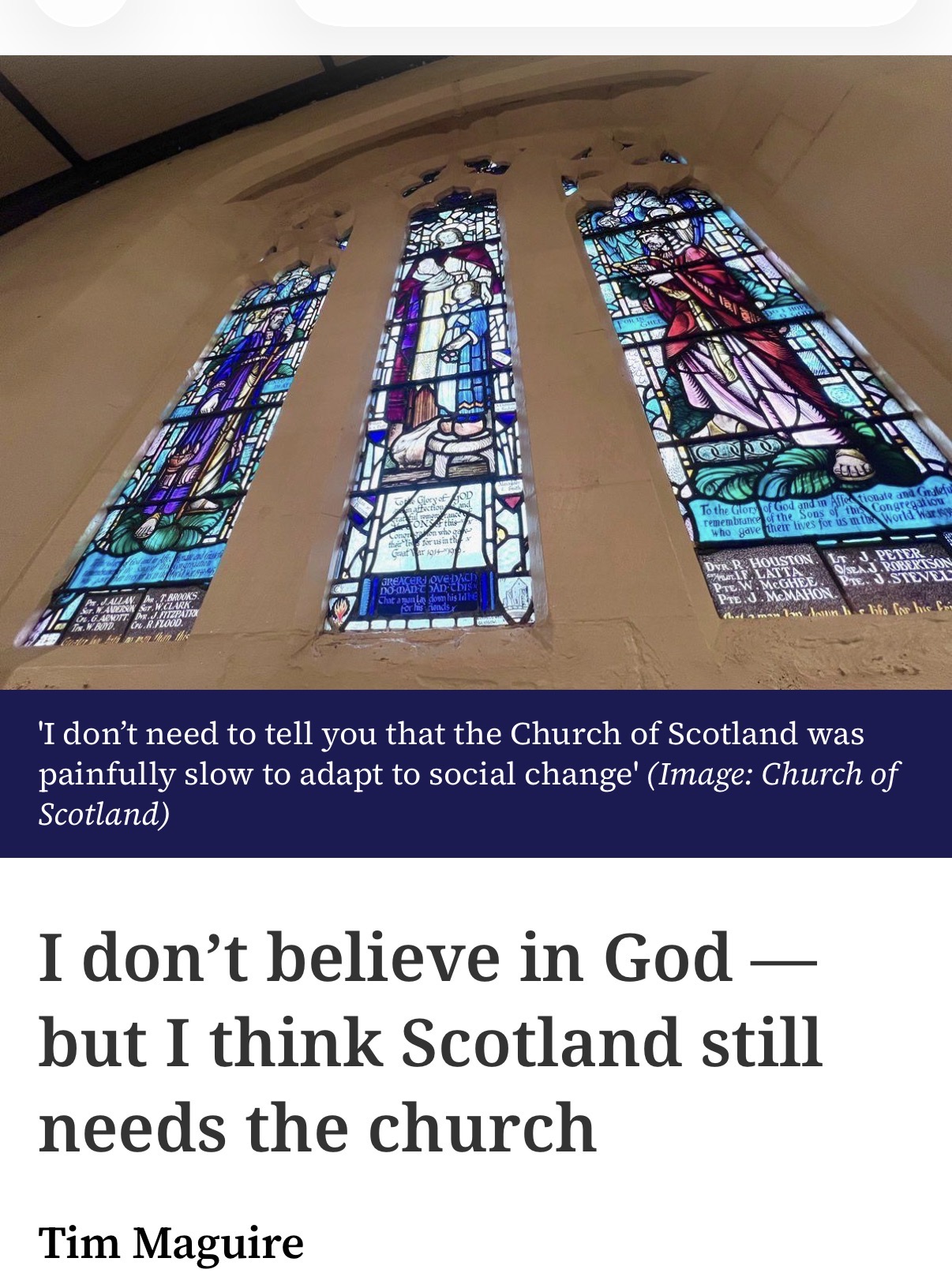
I don’t need to tell you that the Church of Scotland was painfully slow to adapt to social change: slow to welcome gay people fully into the life of the church; slower still to permit same-sex marriage. Yes: the Kirk failed to move with the times, so the times moved on without it.
You know the stats. In 2001, almost half of Scots identified with the Church of Scotland. Today, only 4% do and something similar happened to marriage.
At the start of this century, the Kirk conducted more than 11,000 weddings a year, but the pattern repeated itself and for the past four years, humanist ceremonies have outnumbered not just Church of Scotland marriages, but all religious and belief marriages combined.
As a Humanist celebrant, you might expect me to rejoice; I don’t.
“Rituals,” as Sir Grayson Perry observed, “don’t come out of the ether from God.” They’re how we humans create meaning, and when old rituals lose their meaning, we create new ones. Humanist celebrants like me stepped into that space very successfully. We offered ceremonies that better reflected the values and realities of modern Scotland. But ceremonies are only part of what churches do.
For the past thirteen years I have served as the Honorary Humanist Chaplain to the University of Edinburgh, and for the last three I have worked on the Chaplaincy Team at Napier University alongside ministers, priests, rabbis and imams. Although we start from very different philosophical positions, we are united by a commitment to the common good.
And over time, I’ve come to recognise something important. There are many differences between me and the religious leaders I work beside. But the most important is this: I have a virtual parish. They have a real one.
Yes, I build long term relationships with the families whose weddings, funerals and naming ceremonies I conduct. But when the ceremony ends, I leave. Clergy remain embedded in the daily life of their communities in a way I and most Humanist celebrants do not.
They visit the sick. They organise food banks. They sit with the lonely. They hold communities together quietly, persistently and often invisibly. Yes, the Humanist Society of Scotland did start a soup kitchen in Glasgow which ran for more than a decade, but now it’s become ‘Streetcare’ – an independent charitable institution in its own right (and it’s still doing good work).
The secular Scotland many of us imagined was supposed to replace that infrastructure of care with something better: a strong welfare state, properly funded public services, thriving civic institutions.
Instead, we have food banks, social isolation, exhausted carers and hollowed-out local communities. In that vacuum, churches still matter – not because of their theology, but because they continue to provide forms of solidarity and local presence that few secular institutions have managed to replicate.
Humanists have been very successful at building alternatives to religious ritual. We have been much less successful at building alternatives to religious community.
Perhaps that will change – I hope it does. If secular Humanism is to become more than a philosophy of individual autonomy, it must find ways to root itself more deeply in collective life and mutual care.
And if it does, it could do worse than learn something from movements like the Iona Community: the belief that a meaningful life is built through a commitment to peace, social justice and solidarity with society’s most vulnerable.
Because if those structures disappear entirely, where – exactly – are people supposed to turn?
0 Comments Leave a comment